

 Author:
Mimsy Angeles
The admin worth outsourcing changes as a business grows:
At every stage, the owner keeps pricing, client relationships, hiring decisions, and anything that commits money. Delegate places dedicated admin assistants, executive assistants, bookkeepers, and specialist roles like bilingual paralegals and marketing assistants, starting at $13 an hour, month to month.
Admin doesn’t arrive all at once. It builds up.
One month the founder spends an evening on invoices. A few months later it’s two evenings, plus the calendar, plus the contractor who needs paperwork. Nobody decides to spend a big share of their week on admin. It just ends up that way.
The fix is different depending on where the business is. Outsource too little and the founder becomes the bottleneck. Outsource the wrong things too early and you pay for help you can’t keep busy. So this guide follows one business through four stages, and adds a sample scenario from a different industry at each stage to show how a dedicated assistant fits in.
The main business is made up, but it’s typical: a small online skincare brand. Call it Fern & Field.
Fern & Field starts as one founder, a supplier, and a storefront. She makes the product decisions, answers every customer, and keeps the books in a spreadsheet she updates on Sundays.
At this stage, admin is the stuff that keeps the business running without growing it. Email triage. Scheduling calls with the supplier and the photographer. Sending invoices to her two wholesale accounts, then chasing the one that pays late. Updating product listings. Booking travel for a trade show.
None of it is hard. All of it takes time, and it lands in the hours she’d otherwise spend selling.
What to hand off first:
What to keep: pricing, supplier relationships, and anything a customer would expect to hear from the founder herself.
A part-time assistant is usually enough here. She gets her Sunday afternoons back, and the late-paying wholesale account gets a polite reminder on day three instead of day twenty. If you’re not sure where your hours go, these are the tasks founders usually delegate first.
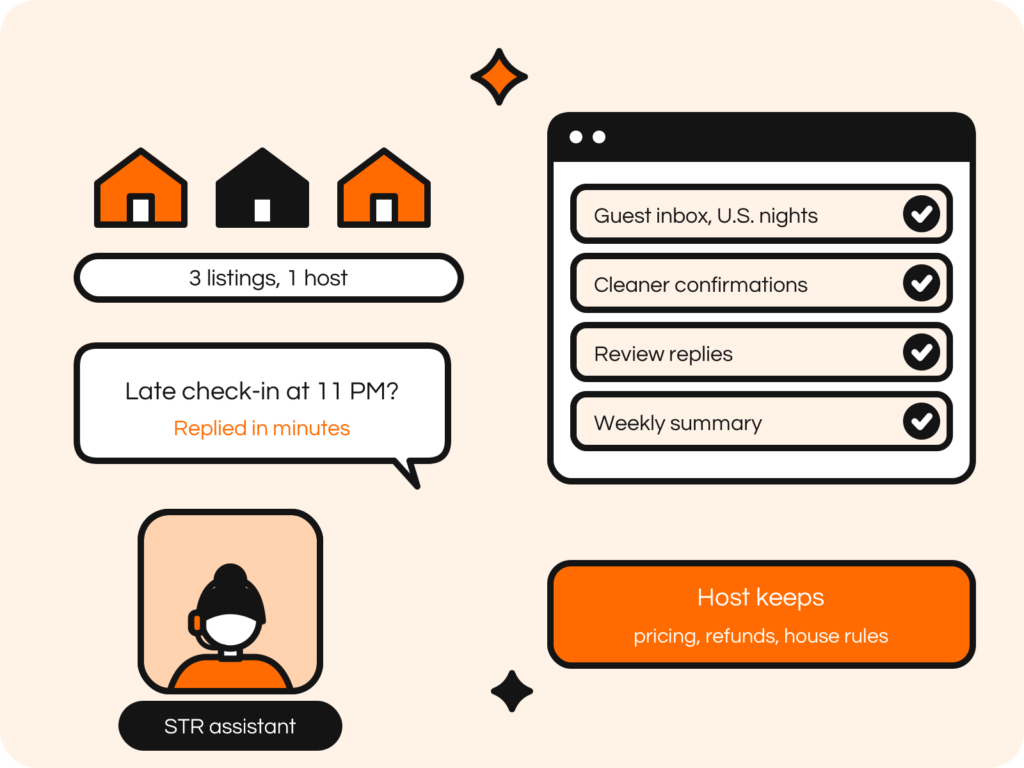
A host runs three vacation rentals alongside a full-time job. Guest messages come in during the workday and late at night, cleaners need confirmations before every turnover, and reviews sit unanswered for days.
A dedicated STR assistant takes the guest inbox, including overnight U.S. hours, since Philippine working hours fall during U.S. nights. The assistant confirms each turnover with the cleaner, replies to every review, and sends the host a short weekly summary. The host keeps pricing, refunds, and house rules. For the host, the difference shows up in the phone: it stops buzzing during meetings, and guests get answers in minutes. These services compare for U.S. rental hosts.
You’ve outgrown this stage when your first hire’s paperwork sits half-finished for a week because nobody owns it.
Fern & Field now has five people: a fulfillment lead, a part-time designer, two customer support reps who started as contractors, and the founder. Revenue is steadier. Admin got heavier, and a lot of it is new.
Hiring creates its own admin. Job posts, interview scheduling, offer letters, onboarding checklists, equipment, logins. Vendors multiply too: the packaging supplier, the fulfillment partner, the software subscriptions nobody remembers signing up for. The books stop fitting in a Sunday spreadsheet.
Customer support is often the first area to need its own person. Two reps can cover weekday hours, but the inbox fills up on weekends and nights, and a slow reply on a damaged order can turn into a bad review.
What to hand off at this stage:
What to keep: hiring decisions, compensation, and vendor contracts.
This is also the stage where the founder’s first assistant either grows into the role or starts drowning in it. One person can’t handle the inbox, the calendar, customer support, and the books well. Splitting the work is usually cheaper than it sounds. These guides cover when to hire a second assistant and how to divide the roles, and how to hire a dedicated bookkeeper when the books need their own owner.
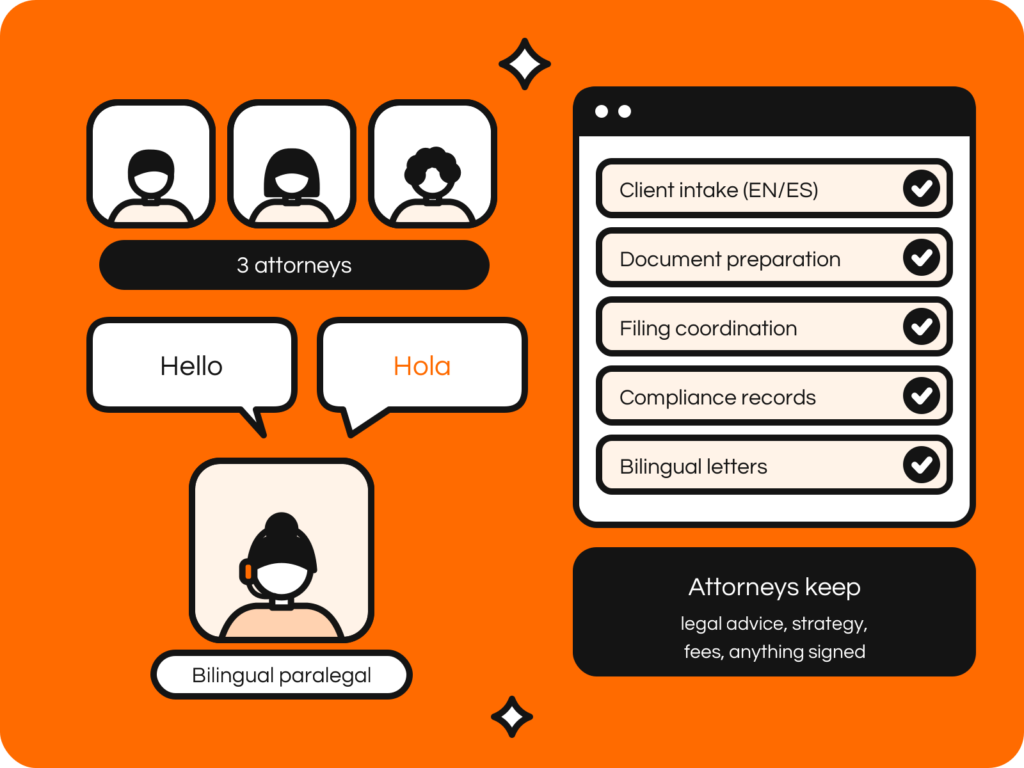
A small firm serves a growing number of Spanish-speaking clients. Intake calls pile up, documents arrive by email in no particular order, and the attorneys spend evenings on filing logistics.
A dedicated bilingual paralegal handles client intake in English and Spanish, prepares legal documents for attorney review, coordinates filings, keeps compliance documentation organized, and manages bilingual correspondence. All of it happens under attorney supervision. The attorneys keep legal advice, case strategy, fees, and anything signed or filed in the firm’s name. For the firm, it means intake stops waiting for an attorney to be free, and the evenings go back to casework.
You’ve outgrown this stage when your team leads start doing their own admin at night, because there’s no one to hand it to.
Fern & Field has 18 people now, with a head of operations, a marketing lead, and a customer experience manager. The founder doesn’t run every department anymore. Her managers do.
The managers inherited the admin too. The marketing lead updates the CRM and pulls the weekly report herself. The operations head chases suppliers for delivery dates. The customer experience manager builds the support schedule in a spreadsheet every Friday. Each of them spends hours a week on work they were hired to oversee.
Admin at this stage is spread out. It lives inside each department, so it’s easy to miss.
What to hand off at this stage:
What to keep: each department’s priorities, budgets, and the decisions that come out of the reports.
One assistant per department often works better than one shared assistant for everyone, because each one learns a single manager’s way of working. The founder usually needs an executive assistant of her own by now. These guides cover executive assistant services, the difference between an EA and a VA, and what a dedicated marketing assistant handles.

A software startup’s marketing lead and one coordinator handle content, social, and the sales pipeline. Posts go out when someone has time, and the sales team keeps asking for more qualified leads.
Two dedicated roles split the work. A lead generation specialist researches prospects, qualifies leads, runs outreach campaigns, keeps the lists clean, and reports on lead flow each week. A social media manager schedules content, writes captions, manages the platforms, monitors engagement, and sends a basic analytics report. The marketing lead keeps the messaging, the budget, and the call on which leads go to sales. The team’s output gets more consistent without adding a full-time marketing hire.
You’ve outgrown this stage when you have three or more assistants and no one person knows who covers what when someone is out.
At 40 people, Fern & Field has several assistants across departments, a few written processes, and a growing number of handoffs. Admin isn’t a pile of tasks anymore. It’s a function, and it needs to be run like one.
Two things change. First, admin becomes a job with a name on it: someone in-house, often an operations manager, owns how admin works across the company. Second, the remote team needs structure. That means written SOPs for recurring work, a backup assigned for every role, and clear rules about who can access what.
What to set up at this stage:
What to keep in-house: the operations lead, and the authority to change processes.
Most of this is setup work that keeps paying off. Start with KPIs and check-ins for a remote team, a zero-trust approach to access, and a clean offboarding process.
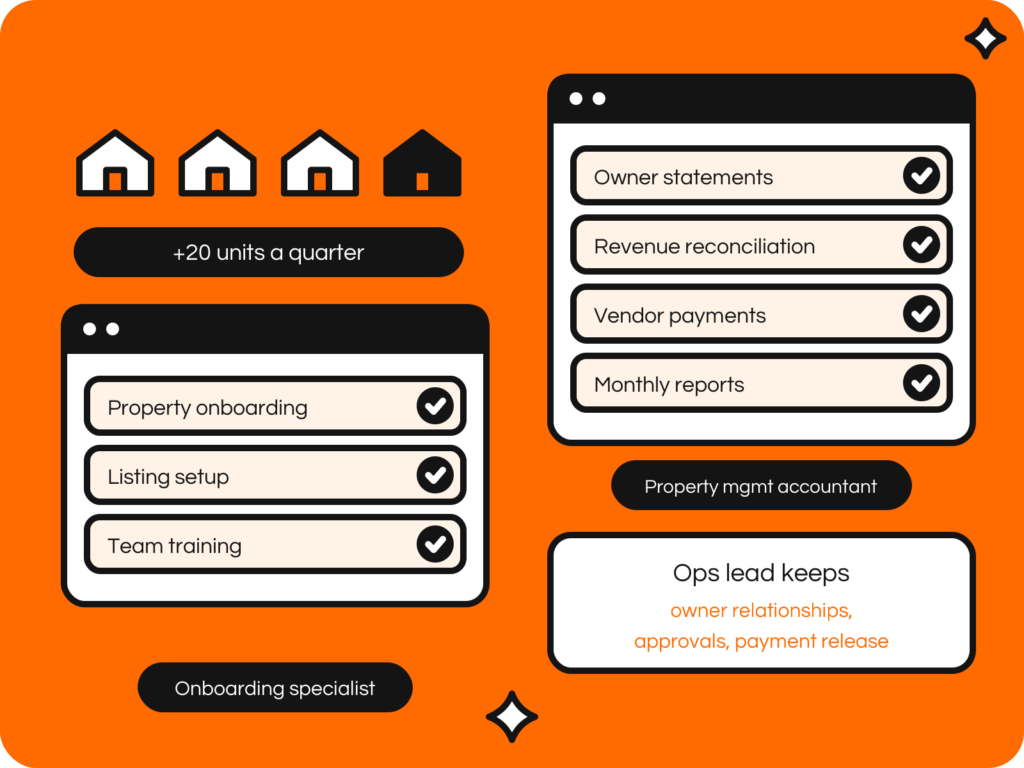
A regional property manager keeps signing new owners. Every new unit means a listing to build, systems to configure, and another owner statement at month-end. The in-house team spends the first week of every month on reconciliations.
Two specialist roles take on the repeat work. An onboarding specialist handles property onboarding, listing setup, and automation configuration, and supports training for the in-house team. A property management accountant tracks expenses across properties, prepares owner statements, reconciles revenue, coordinates vendor payments, and builds the monthly reports. The operations lead keeps owner relationships, approvals, and payment release. New units go live on a checklist, and statements stop running late. More on bookkeeping for multi-property managers and what VAs handle across a growing rental portfolio.
Stage |
Team size (roughly) |
Outsource |
Keep |
|---|---|---|---|
Just You
|
1
|
Inbox, calendar, invoicing, data entry, travel
|
Pricing, key relationships
|
The First Few Hires
|
2 to 10
|
Hiring logistics, vendors, support coverage, bookkeeping
|
Hiring decisions, contracts
|
Managers in the Middle
|
10 to 30
|
Department admin, executive support, project coordination
|
Priorities, budgets
|
Multiple Teams
|
30+
|
Specialized admin roles with SOPs and backups
|
The operations lead, process changes
|
Write it down before you hand it off. A task that lives only in your head is hard to delegate, and the first written version is usually rough. A 30-day onboarding plan gives a new assistant somewhere to start.
Delegate the outcome along with the steps. “Keep the supplier on schedule” holds up better than “email the supplier every Tuesday,” because the assistant can adjust when something changes.
And try not to wait for the breaking point. It’s common to hand off admin later than the business needed it, and by then the cost has already shown up as late invoices, slow support replies, and managers working weekends. This piece covers what that delay costs.
Start with the recurring tasks that pull the founder away from selling: inbox triage, calendar management, invoicing and payment follow-ups, data entry, and travel booking. Hiring logistics, customer support, and bookkeeping usually come next, once the first employees join.
When admin starts taking hours you’d otherwise spend on sales, customers, or your team. For many founders, that’s well before the first full-time hire. These nine bottlenecks are common signs.
Yes, with the right role. A bilingual paralegal can handle client intake, document preparation, and filing coordination under attorney supervision. A property management accountant can handle owner statements and reconciliations. Delegate places both, along with STR, marketing, and executive support roles.
Outsourced, dedicated support usually fits early and middle stages, when the work is steady but doesn’t need someone on-site. Larger teams often combine an in-house operations lead with remote assistants. This comparison covers both options.
Pricing, hiring and compensation decisions, contracts, key client relationships, legal advice, and the authority to change how the business runs.
It depends on the provider, the role, and the hours. Delegate’s dedicated assistants start at $13 an hour, month to month. Before choosing a provider, these ten questions help you compare them.
Fern & Field is made up. The stages aren’t, and neither are the roles in the scenarios above. Delegate has served 140+ businesses, placing STR assistants, bilingual paralegals, marketing assistants, property management accountants, executive assistants, and bookkeepers.
You choose from up to 5 candidates within 3 to 5 days, each one tested through paid work simulations, and only the top 1% of applicants make it through. Your client success partner starts with an SOP consultation, so the handoff is written down before the first week. It’s month to month, starting at $13 an hour, with free replacement while you’re a client.
Which stage are you in? Bring your current admin list to a discovery call, and the Delegate team will tell you what to hand off first.