

 Author:
Blendi Muriqi
Author:
Blendi Muriqi
Hire a second virtual assistant when one area of work keeps slipping because your first assistant is stretched across too many unrelated tasks, or when your business can’t go a day without coverage. Split the work by function, by shift, by client account, or with a lead and support structure. Whichever split you choose, every recurring task needs exactly one owner, handoffs need written rules, and the second assistant should inherit documented processes instead of learning everything from scratch. Delegate places second (and third) assistants through the same vetting and the same provider relationship as the first, starting at $13 an hour.
You’re ready for a second assistant when two or three of these are true:
These line up with the bottlenecks most founders hit, and for STR operators, with the signs a single assistant is stretched too thin.
The hard part is what comes after the hire. Two assistants without a structure often get less done than one assistant with a clear job.
1. Document what your first assistant already does. If their processes live only in their head, the second hire has nothing to learn from, and your first assistant spends weeks training instead of working. Written SOPs are what make a second hire fast.
2. Pick the lane you’re splitting off. Hire for a specific area of work, like bookkeeping, overnight guest messages, or marketing, rather than “more help.” A vague second role turns into two people doing overlapping work.
3. Decide who reports to whom. Either both assistants report to you, or one leads and the other supports. Settle this before day one.
Split |
How it works |
Best for |
Watch out for |
|---|---|---|---|
By function
|
Each assistant owns a different area, such as executive support and bookkeeping
|
Most founders; work that spans unrelated areas
|
Nobody covers a function when its owner is out
|
By shift
|
Same work, different hours, such as overnight and daytime coverage
|
Businesses needing round-the-clock response, like STR guest messaging
|
Handoffs between shifts need tight rules
|
By client or account
|
Each assistant owns a set of clients, properties, or accounts
|
Agencies, property managers, multi-client businesses
|
Inconsistent quality between accounts
|
Lead and support
|
One experienced assistant leads; the second handles volume under their direction
|
Teams planning to grow past two
|
The lead gets stuck managing without the time or pay for it
|
Splitting by function comes up most, and it’s the simplest to manage. Each person gets a clear area, and skill sets can differ by lane. Your bookkeeping assistant doesn’t need to be good at inbox triage.
Splitting by shift suits businesses where response time matters around the clock. A Philippines-based team can cover US overnight hours on a normal daytime shift, while a second assistant takes the US daytime window.
Use a lead structure when you expect a third or fourth hire within the year. Plan for it upfront, though. A lead who manages without the authority or pay to do it well burns out fast. If you promote someone into the role, their pay and recognition should change with it.
An STR operator with 15 properties has one assistant handling everything: guest messages, turnover scheduling, cleaner no-shows, listing updates, and review responses. Guest messages come first because they’re urgent, so listing updates and reviews slide every busy weekend.
The fix combines two splits. The first assistant keeps guest communication, working from a ready library of message templates, and moves to cover the overnight window, when lockouts and late check-in problems tend to happen. The second assistant takes daytime operations: turnovers, vendor coordination, listing updates, and reviews, using documented SOPs for each. Each owns a function, they work different hours, and they hand off twice a day through a shared board.
Nothing gets pushed to next week anymore, because nothing is competing for the same person’s attention.
Give every recurring task one owner. Shared ownership usually means nobody owns it. Write it down:
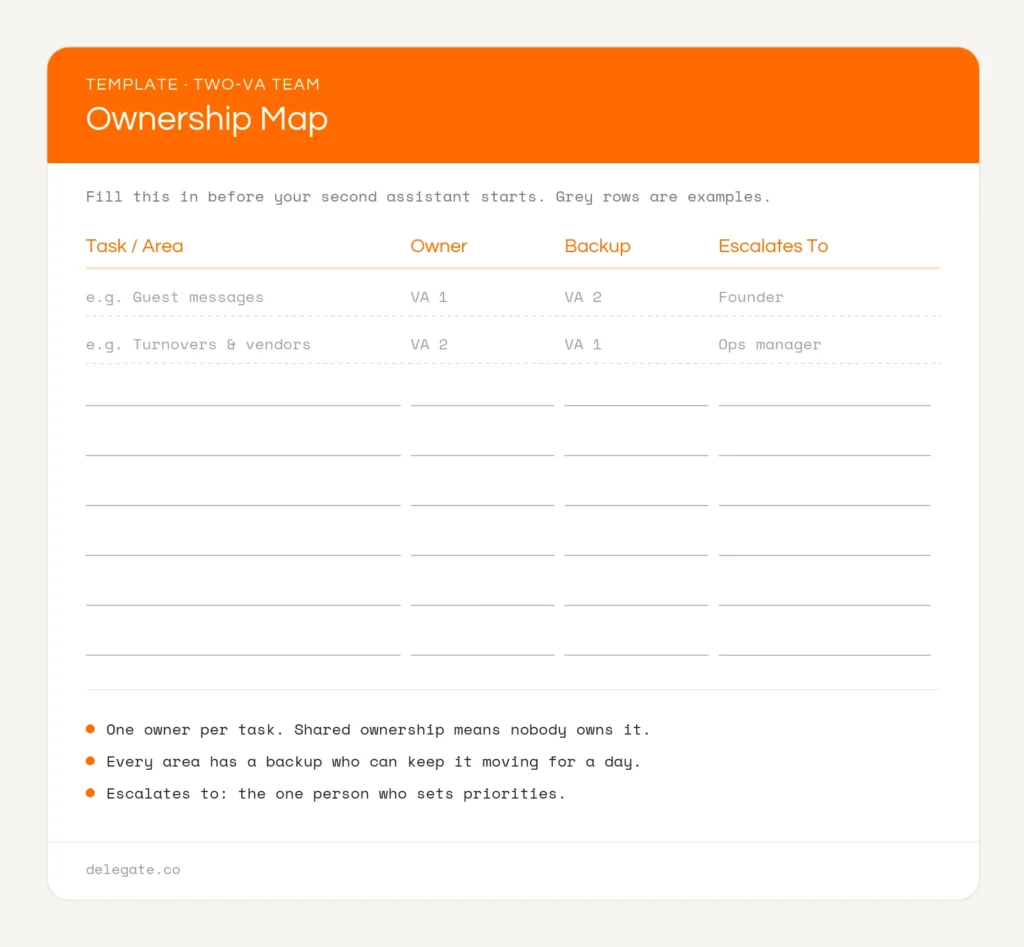
Name a backup for each area. Your bookkeeping assistant doesn’t need to be an expert in guest messages, but they should know the basics well enough to keep things moving for a day. Cross-train on the SOPs for the three or four tasks that can’t wait.
Use one shared task board. Every task gets an owner, a status, and a due date, visible to both assistants and to you.
Write handoff rules. When work moves between people, like a guest complaint that becomes a refund request or a night-shift issue still open at shift change, define who owns it at each step. A two-line note at every handoff (what happened, what’s still open) prevents most dropped balls.
Keep one source of priorities. If you, your business partner, and your operations manager all give instructions, your assistants end up with three conflicting to-do lists. Pick one person who sets priorities.
Set up access for two people. Each assistant gets their own login with permissions scoped to their lane. Shared credentials make it impossible to revoke one person’s access without locking out the other.
Splitting one lane in half. Two assistants sharing the same inbox, with no clear rule for who answers what, creates duplicate replies and missed messages.
Hiring a copy of the first assistant. If you’re splitting by function, the second hire needs the skills for their lane, not the same profile you hired last time.
Turning your first assistant into an unpaid manager. If they’re training, reviewing, and coordinating on top of their own work, recognize it formally or keep management with you.
Skipping the ownership map. Without it, both assistants assume the other one has it.
Letting both assistants bring you the same questions. Route questions through the task board or a shared channel so you answer once.
A second assistant roughly doubles your hourly spend. At $13 an hour, 40 hours a week adds about $520 a week. The better question is whether the lane you’re splitting off is losing you more than that: missed reviews, late invoices, slow guest replies, or your own hours spent covering the gap.
For STR operators with larger portfolios, Delegate offers a discounted per-property rate, which changes the math as you add units. The pricing guide covers typical rates by role and country.
Adding a second assistant through Delegate works like the first:
When one area of work keeps slipping because your first assistant is stretched across too many unrelated tasks, when a single day out creates a backlog, or when you’re holding back new work because your assistant is at capacity.
By function (each owns a different area), by shift (same work, different hours), by client or account, or with a lead and support structure. Splitting by function is the most common and the simplest to manage.
Only if you give them the authority, the time, and the pay to do it. Otherwise, keep both reporting to you until you’re ready for a formal lead role.
Give every recurring task one owner, use a single shared task board, and write down handoff rules for any work that passes between them.
Usually not. If you’re splitting by function, hire for the skills the new lane needs. If you’re splitting by shift, similar skills make sense because the work is the same.
Roughly the same as the first. At Delegate’s $13 hourly starting rate, a full-time second assistant adds about $520 a week. STR operators with larger portfolios can get a discounted per-property rate.
The first hire is where you learn what you actually need. The second should build on that, with the processes documented, the lane chosen, and the structure decided before anyone starts.
That’s how Delegate handles it. Tell us which lane is slipping, and we’ll bring you vetted candidates for that specific role, with an SOP consultation that gets your second assistant working from written processes instead of guesswork. Pricing starts at $13 an hour, month to month, with free replacement for as long as you’re a client.
Book a strategy call and bring your ownership map, even a rough one. We’ll help you figure out where the split should be.