


TL;DR
Founders who delegate well grow faster. In Gallup’s study of 143 Inc. 500 CEOs, strong delegators averaged 1,751% three-year growth and earned 33% more revenue than weak delegators. The catch: most founders aren’t naturally good at it. Delegation works when you match the task to the right person, give clear context and a clear level of authority, and check in at set points. For founders without a team yet, a dedicated virtual assistant from Delegate is often the first place to start.
Ever wondered how Bill Gates turned Microsoft into a tech giant?
Part of the answer is smart delegation. As Microsoft grew, Gates handed more and more of the company’s management to others. Steve Ballmer became president in 1998 and CEO in 2000, while Gates moved into the role of chief software architect to focus on product. He kept the work only he could do and trusted others with the rest.
Most startup founders face the same choice much earlier, and with a much smaller team.
The Numbers Behind Delegation
Delegation often gets treated as a soft skill. Gallup’s research suggests it’s closer to a growth driver.
In a 2014 study of 143 CEOs on the Inc. 500 list of America’s fastest-growing private companies, Gallup found that CEOs with high “Delegator” talent:
- Averaged 1,751% three-year growth, 112 percentage points higher than CEOs with limited or low delegation talent
- Earned 33% more revenue: $8 million versus $6 million
- Created more jobs: 21 in three years, compared with 17
A companion Gallup study of 1,446 US employer entrepreneurs found that 75% had limited to low Delegator talent. In other words, most founders aren’t naturally good at handing work off. It’s a skill most of them have to build on purpose.
The data is more than a decade old, but the pattern it describes hasn’t changed: a founder who holds on to everything becomes the ceiling on how fast the company can grow. The signs usually show up in the same places: slipping follow-ups, a calendar with no room to think, and growth work that keeps losing to admin.
Giving to Gain
Delegation means giving away some work so you can keep control of what matters most. You keep control of what matters by handing off what doesn’t.
A founder’s hours are the scarcest resource in the company. Every hour spent on invoices, scheduling, or inbox triage is an hour taken from product, customers, or fundraising. That cost adds up faster than most founders expect, and it rarely shows up anywhere you’d notice it until something important slips.
Delegation also builds trust. Each time you hand something off and it comes back done well, you trust that person with a little more, and the team gets better at working without you in the room. A team that can do that is a real advantage at the stage where most startups stall.
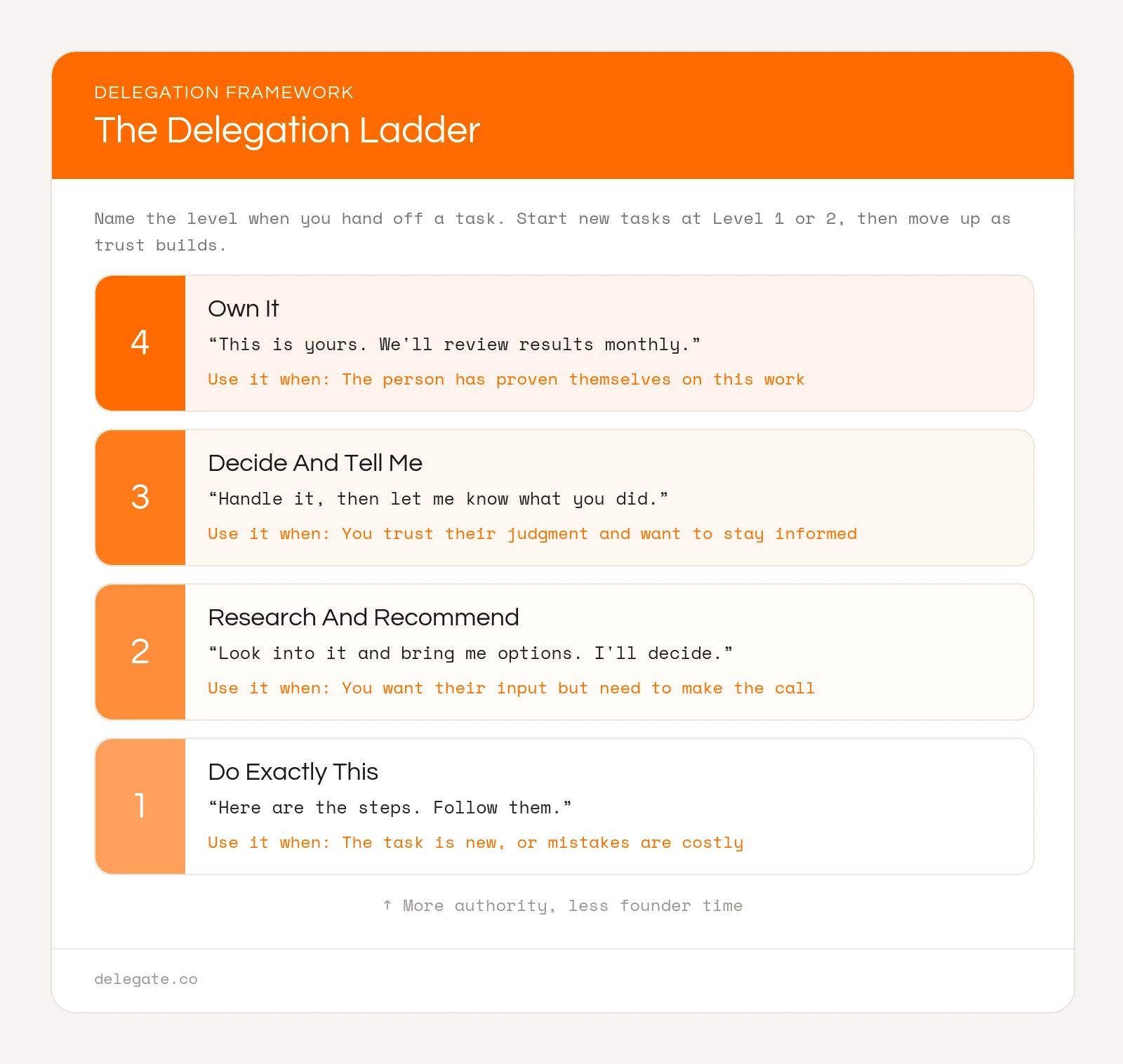
The Delegation Ladder: Four Levels of Handing Off Work
Delegation isn’t just about assigning tasks; it’s a trust-building exercise. This trust is like magic glue that binds your team together. For startup founders, building a motivated, cohesive team is like having a secret weapon in your arsenal.
How to Hand Off a Task Well
Match the task to the person’s strengths. Delegation works best when the work fits what someone is already good at. A detail-oriented person will do better with bookkeeping than with sales calls.
Explain the why and what success looks like. Leaders who delegate well explain the purpose, the outcome, and how they’ll judge the result, in plain language. A short written brief does this better than a verbal handoff:
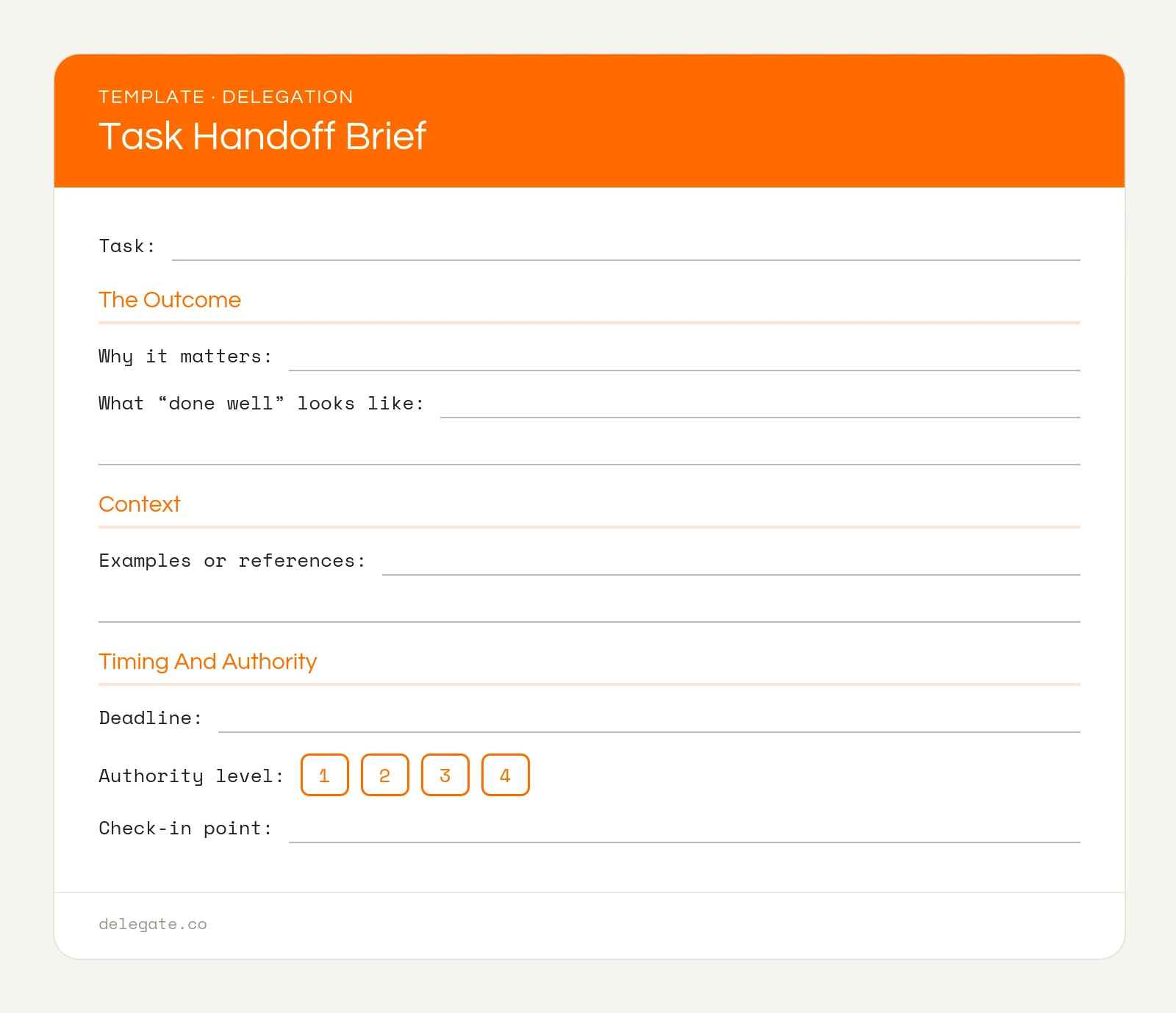
Build in accountability. Regular check-ins or simple performance metrics catch problems while they’re still small. As trust grows, check-ins get less frequent.
Write it down once. A task explained once and documented can be handed off again and again. Written SOPs turn a one-time handoff into a system.
When There's No Team to Delegate To
Many early founders read advice like this and think, “Delegate to whom?”
That’s where outside support comes in. The work founders usually hand off first, like inbox and calendar management, bookkeeping, customer replies, and CRM updates, is well suited to a virtual assistant. A few choices shape how that goes:
- Virtual assistant or executive assistant? A VA handles process-driven work. An EA handles judgment calls about your time and priorities. Here’s how to tell which you need, and what founders should know about executive assistants.
- Remote or in-house? For most early-stage startups, a dedicated remote assistant costs less and flexes more than an in-house admin hire.
- Managed or freelance? A managed provider handles vetting, onboarding, and replacement. On a freelance marketplace, all of that falls to you.
- Finance is its own case. Books need a specialist. The startup bookkeeping guide covers when to hire and what to hand off.
Hiring well matters as much as delegating well. Gut-feel interviews are a common reason remote hires fail. This step-by-step hiring guide walks through the full process, and a structured 30-day onboarding plan gets a new assistant working independently within the first month. Before sharing any logins, set up access properly.
Frequently Asked Questions
Why is delegation important for startups?
Founders have limited time, and every hour on routine work is an hour taken from product, customers, and growth. Gallup’s research on Inc. 500 CEOs found that strong delegators averaged 1,751% three-year growth and earned 33% more revenue than weak delegators.
What should a startup founder delegate first?
Recurring work with a clear right answer: inbox and calendar management, bookkeeping, data entry, customer replies, and CRM updates. Keep strategy, key relationships, and final decisions for yourself.
How do I delegate without losing control?
Name the level of authority up front, from “do exactly this” to “own it,” write a short brief with the goal and deadline, and set check-in points. Control comes from clear expectations, not from doing the work yourself.
Why do so many founders struggle to delegate?
Most aren’t natural delegators. Gallup found that 75% of employer entrepreneurs have limited to low delegation talent. It’s a skill that improves with practice and simple systems like written briefs and SOPs.
Who can a founder delegate to without a team?
A dedicated virtual assistant is a common first step. Pricing depends on role and hiring model, and our 2026 pricing guide breaks down the options.
Your First Level-4 Task Is Closer Than You Think
Delegation is a skill that improves with each handoff. The founders in Gallup’s study weren’t strong delegators by accident. They built the habit, and it showed up in their growth.
If you don’t have anyone to delegate to yet, Delegate can close that gap. We place dedicated, vetted assistants with startup founders, starting at $13 an hour, month to month. Onboarding includes an SOP consultation, so your first handoffs get written down from day one, and you choose from up to 5 candidates within 7 to 14 days of a kickoff call.
Book a strategy call and bring the one task you’d hand off first.