

 Author:
Bea Generalo
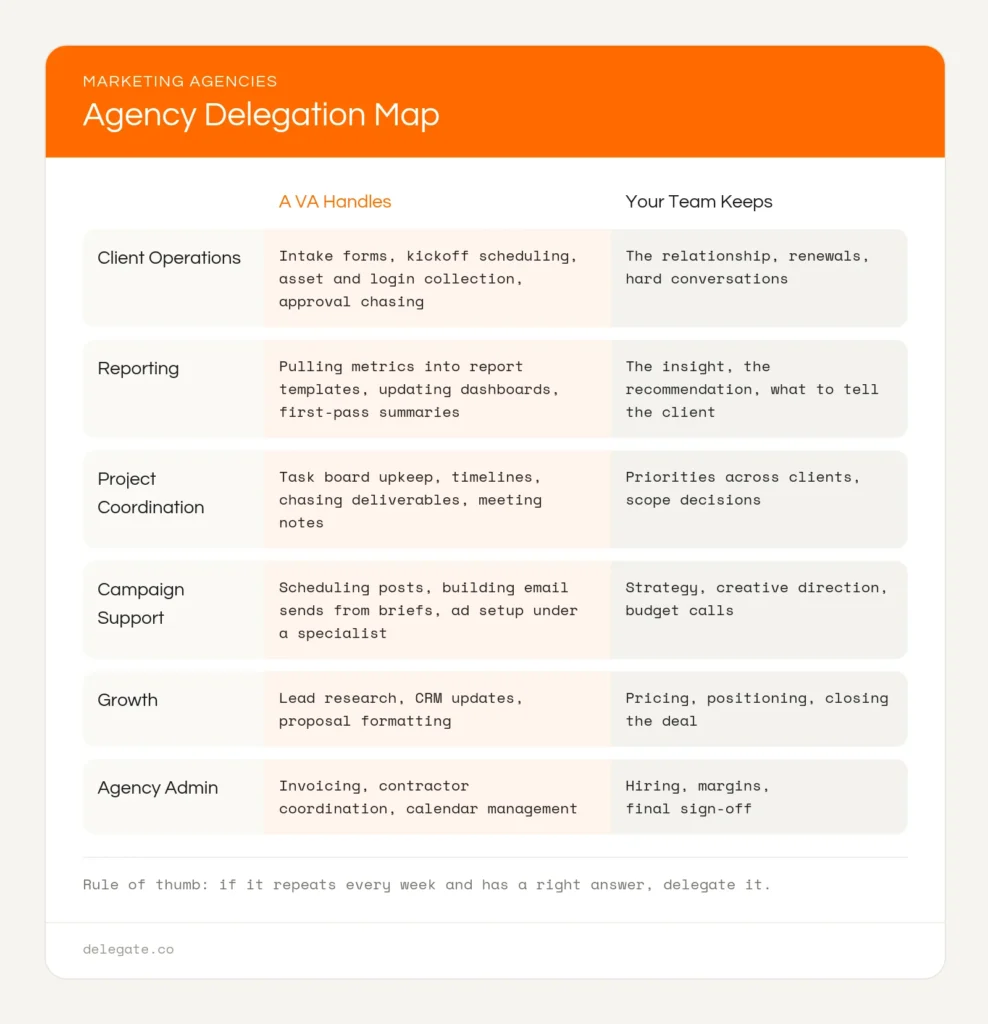
A virtual assistant takes delivery admin off your senior team: client reporting, onboarding and asset collection, project coordination, and campaign execution from briefs. Strategy, creative direction, and the client relationship stay with you. For agencies, two setup questions matter most: how one assistant covers several clients without mixing them up, and how you manage access to every client’s accounts. Delegate places dedicated marketing assistants trained across content and design, scheduling, paid ads, and SEO tools, starting at $13 an hour, month to month.
A retainer is a fixed number. Every hour your team spends on work that isn’t strategy or creative comes straight out of your margin.
Picture a 12-client agency with two account managers. Monday mornings go to pulling numbers from five platforms into report decks. Tuesday goes to chasing a client for brand assets, updating the task board, and rescheduling a kickoff call. The strategy work clients actually pay for gets squeezed into Thursday afternoon.
The client pays for the insight in the report. They don’t care who copied the numbers into it. That copying, chasing, and coordinating is exactly what a virtual assistant handles.
Client operations
Reporting
Project coordination
Campaign support
More on how VAs support campaign work.
Agency growth
Agency admin
A remote assistant can also clean up a messy CRM and financial records that fell behind during a busy quarter.
This is where agency setups differ most from a single-brand hire. A good agency assistant keeps five clients’ brand voices, calendars, and approval contacts straight without mixing them up. That takes structure:
For a look at which providers are built for multi-client work, see our comparison of marketing assistant companies for agencies.
Clients should see your agency, every time.
An agency assistant may need access to dozens of client ad accounts, analytics properties, and content systems. Shared logins across all of them turn one departure into a security problem.
Weeks 1–2: reporting prep and asset chasing. Both repeat every week, have clear outputs, and are easy to check.
Weeks 3–4: client onboarding and the task board. Once your assistant knows your clients, they can run intake and keep projects moving.
Month 2: campaign execution from briefs. Scheduling and email builds need a feel for each client’s voice, so they come after the assistant knows the accounts.
Document each process as you hand it over, and use a structured 30-day plan so onboarding doesn’t drift.
Run it with your own numbers. Take what one hour of your account manager’s time costs you, and multiply by the admin hours they spend each week. That’s what the current setup costs.
Twenty hours of assistant time at $13 an hour costs $260 a week. If those twenty hours come off your account managers’ plates, they go back to strategy, better client work, or room for another retainer. The full pricing guide covers rates by country and hiring model.
Four questions sort providers quickly:
1. Is the assistant trained on marketing tools, or only general admin?
2. Have they supported several clients at once?
3. How is access to client accounts handled and removed?
4. What happens if the assistant is out or leaves mid-campaign?
A freelancer can work for a single project. For ongoing delivery across clients, a managed arrangement carries vetting, coverage, and replacement for you. Our guide to choosing virtual marketing support goes deeper.
Client reporting, onboarding and asset collection, project coordination, campaign execution from briefs, CRM upkeep, lead research, invoicing, and contractor coordination.
Yes, with structure: a folder per client, one task board tagged by client, consistent naming, and capacity planned around weekly volume rather than client count.
Yes. Give them an agency email address and signature, decide how you’ll introduce them to clients, and check your client contracts for any limits on subcontracting or data access.
Through each platform’s own user roles with limited permissions, plus a password manager for anything else. Remove access whenever a client account ends.
Reporting prep and asset chasing. Both repeat every week, have clear outputs, and are easy to check before you hand over anything client-facing.
Philippines-based support commonly runs $5 to $17 an hour. Delegate’s marketing assistants start at $13 an hour, with recruiting, onboarding, and replacement included.
The work your clients pay for happens in strategy calls and creative reviews. The work that eats your team’s week happens in spreadsheets, inboxes, and task boards.
Delegate places marketing assistants who take that second category off your team, trained on the tools agencies run and vetted on real scenarios before you meet them. Pricing starts at $13 an hour, month to month, with free replacement for as long as you’re a client.
Book a strategy call and bring your client list. We’ll map which delivery tasks one assistant could own across your accounts.