
 Author:
Bea Generalo
Author:
Bea Generalo
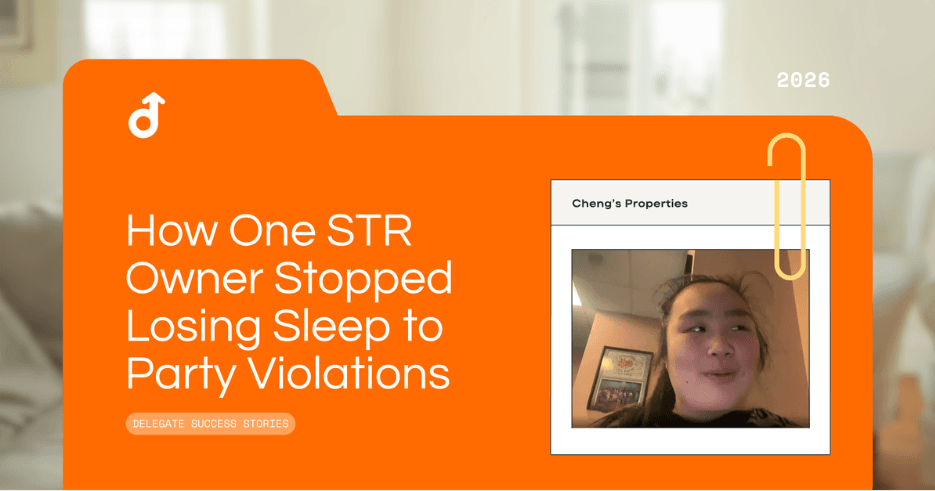
Kimberly Cheng, owner of Cheng’s Property, was running her short-term rental business the way a lot of hosts start out: doing everything herself, all the time, because there was no system telling her she didn’t have to.
Before working with Delegate, Kimberly was losing sleep over party violations, manually tracking every inquiry, and staying reachable around the clock because nothing else was catching what she wasn’t personally watching. She wasn’t running a portfolio. She was working as the full-time concierge for her own listings, on call for anything that came up, at any hour.
That kind of setup can hold for a while. It doesn’t scale, and it doesn’t leave much of an evening that actually belongs to the owner.
One of the clearest examples came up in her own words, describing a double-booking that could have gone badly.
“Sometime that it overbook or a double-book, but you guys were able to help us like have a reasonable reason and explain to the customer, and you guys were able to realize it early enough so the customer were have enough time to find a different unit,” Kimberly said. “And also protect our status with all of these customers and also all of these platforms that we work with, which kind of really avoid a lot of bad reviews that we are able to get and also a lot of fees that we have to be charged because of that.”
The detail that matters here isn’t just that the mistake got caught. It’s that it got caught early enough to still be fixable, with enough time for the guest to find another place, without it turning into a platform penalty or a bad review. That’s the difference between a support team reacting to a problem and one that’s actually watching for it.
The results were concrete: consistent guest management, zero party violations, and evenings she actually got to keep for herself. She stopped being the person personally fielding every message and started operating the way a portfolio owner actually should, with a system running the day-to-day instead of her own attention stretched across every listing at once.
She didn’t need more hours in her day. She needed better back-office infrastructure, something built to catch the double-booking before it became a lost guest, and to handle the party violation before it became a pattern.
Kimberly’s story is a common one: a host who’s capable and hands-on, running everything personally because nothing else exists to catch what she’d otherwise miss herself. The gap usually isn’t effort. It’s infrastructure, and the fix tends to be smaller than it feels from the inside.
If double-bookings, late-night guest issues, or inconsistent tracking sound familiar, it’s worth seeing what a dedicated STR back-office actually catches before deciding it’s just part of running the business.
Book a discovery call to see what that could look like for your properties.