

 Author:
Blendi Muriqi
Author:
Blendi Muriqi
Most bad bookkeeper hires go wrong at the definition stage, not the interview. Founders write “bookkeeper” in a job description, assume it means the same thing everywhere, and end up either overpaying for controller-level work or underpaying someone who can’t actually keep books clean. Here’s the six-step process for getting this hire right the first time.
This is the step that determines everything after it. A bookkeeper, an accountant, and a controller are genuinely different roles, a bookkeeper records what happened, an accountant interprets it, a controller runs the full financial operation. Writing “bookkeeper” without specifying which of these you actually need is how founders end up paying controller rates for data entry, or hiring someone who can’t handle what the job actually requires.
Before writing anything, get specific about:
A quick template worth using:
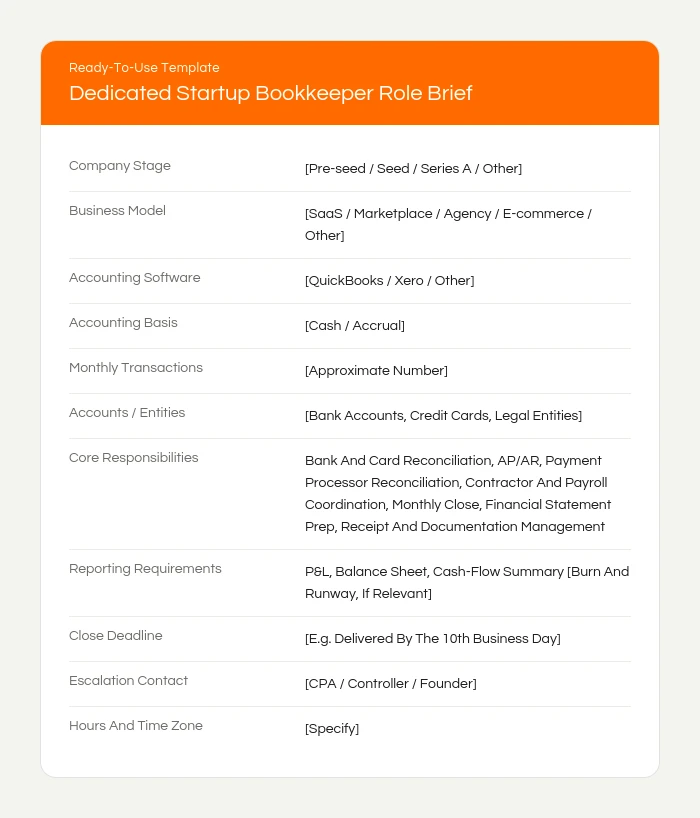
Filling this out before you contact anyone forces the clarity that prevents most mismatches downstream. A vague brief produces vague candidates.
Five real options exist, not just two, and they’re not interchangeable:
Don’t pay for dedicated capacity you don’t need. If the actual workload is a few hours a month, a basic service is the right fit, not a dedicated hire sitting underutilized.
For most early-stage startups with real, ongoing transaction volume, a dedicated outsourced bookkeeper through a managed provider is the practical middle ground, consistency and context without the cost of a full-time local hire.
A resume tells you what someone claims. Good questions reveal how they actually think. Cover both the technical and the behavioral.
Technical questions worth asking:
Behavioral and trust questions worth asking:
Red flags worth taking seriously:
An interview tells you who’s confident. A test task tells you who’s actually good. Give a candidate a small, realistic, anonymized sample:
Ask them to categorize the transactions, identify anything missing, explain their reconciliation logic, flag what they’d escalate rather than decide on their own, and summarize what they’d need before calling the period closed.
What to actually score:
Criterion |
What good looks like |
|---|---|
Accuracy
|
Transactions categorized consistently, errors identified
|
Judgment
|
Doesn't guess when information is incomplete
|
Reconciliation logic
|
Can clearly explain how balances get verified
|
Startup awareness
|
Recognizes processor fees, accruals, or deferred revenue where relevant
|
Communication
|
Questions and risks are explained clearly, not vaguely
|
Security instinct
|
Treats financial data and access with real care, not casually
|
Pay for the time, this is real work. Never grant live system access as part of a test, use anonymized or sample data only.
Whoever you hire will have visibility into sensitive financial data, this deserves real scrutiny before you grant access.
Before anyone touches your books, get specific about:
“Monthly bookkeeping” isn’t specific enough as a scope. The clearer this is upfront, the fewer surprises later.
A structured first month tells you far more than waiting for something to go wrong.
Before day one: have accounting software access, the chart of accounts, recent bank and card statements, current financial reports, and vendor and customer lists ready. Don’t make day one a scramble to gather basics.
Week 1: the bookkeeper should be learning your business, revenue model, billing cycle, expense policies, approval workflow, not yet making independent decisions. Start with read-only or limited access where practical.
Weeks 2 and 3: guided execution. They reconcile accounts, flag uncategorized items and missing receipts, and document open questions rather than guessing through them.
Week 4: a supervised close, reviewed by you, a controller, or your CPA, checking reconciliations, accruals, AP/AR, and anything unusual before the relationship moves to independent ownership.
By day 30, confirm the close deadline, reporting package, communication cadence, escalation process, and backup coverage are all actually working as designed, not just agreed to in theory.
Writing “bookkeeper” in a job description without specifying which layer of financial work they actually need, recording, interpreting, or full financial operations. This mismatch causes more bad hires than a weak interview process does.
Yes. A real, paid test task, reconciling a sample bank statement or categorizing a batch of transactions with built-in ambiguities, reveals accuracy and judgment in a way an interview alone can’t.
Cover both technical ground (reconciliation process, payment processor handling, cash vs. accrual accounting, deferred revenue) and behavioral ground (a real past mistake, how they’d handle a suspicious vendor bank-detail change request, what they’d want to know about your business first). Vague or defensive answers on either front are a real signal.
Use a password manager for credential sharing, grant read-only or accountant-level access where the platform allows it, keep payment approval separate from the person doing the bookkeeping, and document what happens to access when the engagement ends.
It depends on volume. A basic service fits low, simple transaction volume needing just monthly reconciliation. A dedicated bookkeeper makes sense once the workload is consistent enough that one person learning your specific systems actually pays off.
A freelancer can work for a narrow, well-defined engagement. A managed service is typically the more practical choice for ongoing bookkeeping, since vetting, continuity, and replacement are handled as part of the arrangement rather than left entirely to you.
Independently approve unusual payments, change vendor banking details, make material accounting-policy decisions, or alter financial records without documentation. Any of these happening without a clear approval trail is worth addressing immediately.
Delegate places dedicated bookkeepers trained on your accounting software before placement, with a defined catch-up process and replacement coverage if the fit isn’t right.
Explore dedicated assistants or book a strategy call to get matched.