
 Author:
Bea Generalo
Author:
Bea Generalo
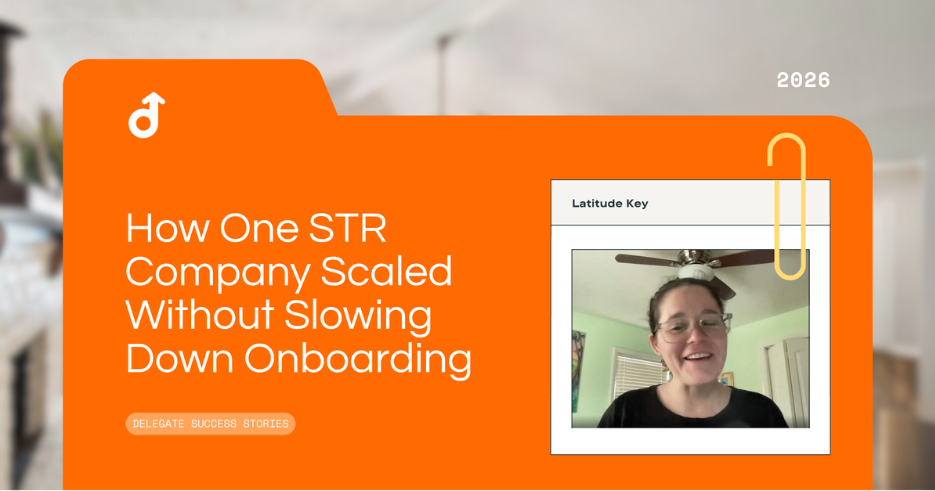
Megan Place watched Latitude Keys hit a wall a lot of growing STR companies hit: more properties, more reservations, and a team already stretched to keep up with existing listings, let alone new ones. As the company grew, guest inquiries grew with it, and there were only so many hours in a day to answer them.
Latitude Keys was already working with Delegate before this specific need came up, which made expanding that support a natural next step rather than a new vendor search. As reservations increased, guest inquiries piled up after hours, and the internal team had no real path to add properties without guest satisfaction slipping on the ones they already had.
That’s the part that trips up a lot of growing STR companies. Adding properties is the easy decision. Building the operational capacity to actually support them without breaking what’s already working is the harder problem.
The obvious fear with bringing on more support is the ramp-up cost. Every new hire typically means teaching them the basics first, email, scheduling, general admin, before they’re anywhere close to useful on the actual work. For a company trying to scale quickly, that lag is exactly the kind of friction that makes growth feel riskier than it should.
The distinction that actually solved this wasn’t more people. It was people who didn’t need to be taught the fundamentals first.
“So they, you know, when they come into a new program, it’s not that you’re teaching somebody basic skills such as like email, you know, the Gmail Suites, and things that people should know. They come in with those basic skills, and then we’ll just add on the unique things that we have, so it’s, it’s an easier process in the way that you bring in people,” said Megan Place, describing her experience with Latitude Keys.
Watch the full testimonial here
That difference is what actually removed the bottleneck. Instead of spending onboarding time on basic administrative skills, the team could go straight to teaching what was actually unique to Latitude Keys, and get new support contributing meaningfully far faster.
With the extra support in place, Latitude Keys added more properties to their portfolio while maintaining the same level of service on their existing listings. The internal team gained a better work-life balance as reservations increased, and guest happiness improved alongside it rather than declining under the added volume.
The result wasn’t just more capacity. It was proof that scaling and quality didn’t have to trade off against each other, as long as the people coming in were ready to contribute from day one instead of needing to be built up first.
This experience points to something worth checking directly with any provider: whether new hires arrive pre-trained on the platforms and fundamentals your business already runs on, or whether that gets built from scratch on your team’s time. A structured onboarding process matters, but starting from a baseline of real competence matters just as much, and documented SOPs from day one are what make that baseline transferable to the next hire too.
If growth is starting to feel like it comes at the cost of service quality, that’s usually one of the clearest signals a single team is already stretched past capacity. It’s worth seeing what a dedicated STR assistant relationship actually looks like before assuming the trade-off is unavoidable.
Book a discovery call to see what that could look like for your portfolio.